
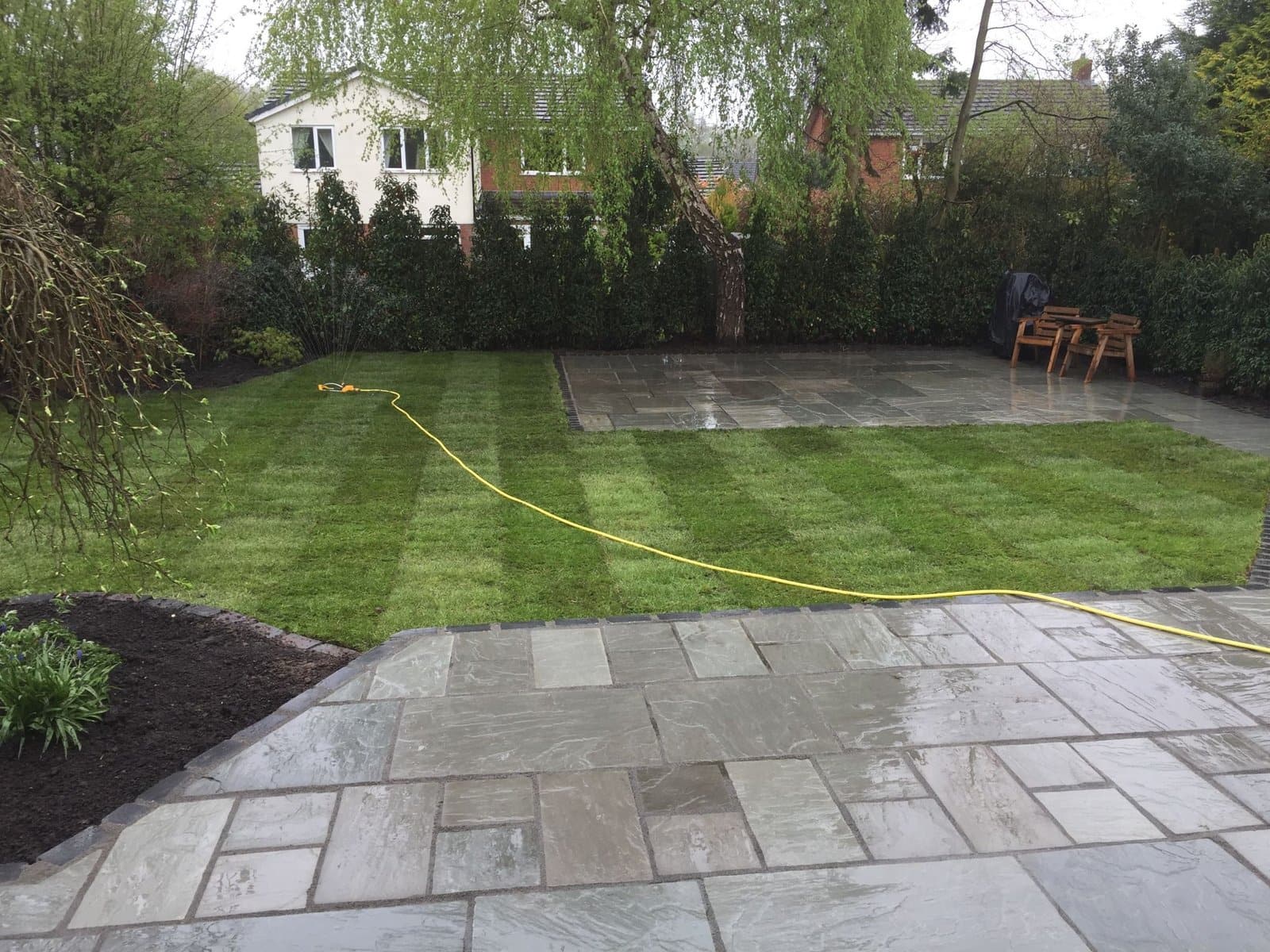
Porcelain patio cost guide
Porcelain patio costs, without the mystery.
Our genuine trade prices — porcelain at £25/m² against £30–£70 retail — and an honest look at the groundwork and skilled laying that turn tiles into a terrace.
The tile is the cheap part
Porcelain has become the default for modern Cheshire patios for good reason: it doesn’t stain, doesn’t fade, and shrugs off North West winters. And the surprise for most homeowners is that the tiles themselves are now no dearer than good sandstone.
The real cost of a porcelain patio is in what you don’t see: the excavation, the compacted sub-base, the full mortar bed with priming slurry on every slab, and the precision cutting. Here’s how each piece prices up.
Our real trade prices — Francome’s of Ollerton, August 2026
What porcelain actually costs us — and you
Porcelain — our trade price
£25 /m² ex VAT
What we actually pay on recent Francome’s supplier quotations — below even the cheapest DIY-store tile. The difference goes into your quote, not our margin.
Porcelain — retail
£30–£70 /m²
The same category browsed online: standard 20mm tiles from £30.56/m², mid ranges £43–£46/m², premium designer lines £53–£70/m².
MOT Type 1 — our trade price
£29.99 /tonne
Bought loose by the tonne on trade. In retail bulk bags the same stone works out at roughly three times as much per tonne — and a 30m² patio uses 8–11 tonnes.
Bed & fixings — our trade prices
£5.85–£48.50
Cement £5.85 a 25kg bag, washed grit sand £38.69 a bulk bag, slurry primer £21.43, two-part epoxy jointing compound £48.50 — the consumables a proper porcelain job actually uses.
Trade prices are ex VAT, taken from genuine recent supplier quotations on our account at Francome’s, the family-run builders’ merchant in Ollerton; retail comparisons are national merchants’ online listings including VAT, checked August 2026. Materials sourced through our trade account typically run 30–40% below retail — savings passed on in the quote.
Five things that move the price more than the tile
Two 30m² porcelain patios can be quoted thousands apart and both be priced honestly — because these five factors differ garden to garden. A written quote should show you where yours sit.
Ground conditions
Cheshire clay holds water and moves. Wet or made-up ground needs a deeper dig and more stone — the sub-base is typically 100–150mm compacted, depending on what we find.
Access
A rear garden reached through a passage means every tonne — out and in — travels by barrow. Machinery access genuinely changes the labour on the quote.
Size & shape
Bigger is cheaper per metre: setup, delivery and waste spread further. Curves, steps and multiple levels add cutting time — porcelain cuts beautifully, but slowly.
Replace vs new
Lifting a failed patio adds breaking-out and disposal — but if the old base is sound, it can sometimes be reused. We tell you which honestly, because it changes the number meaningfully.
Drainage & falls
Porcelain is non-porous, so every drop of rain goes where the falls send it. Getting that right — channels, gullies, soakaways where needed — is part of the job, not an extra.
The laying itself
Full mortar bed, priming slurry on every slab, no dot-and-dab voids, precision cuts. Skilled-trade work, and the single biggest reason quotes differ.
A worked example — 30m² porcelain patio
At our trade prices, 30m² of porcelain is £750 in tiles (ex VAT). The sub-base takes 8–11 tonnes of MOT Type 1 — £240–£330 loose at £29.99 a tonne — then grit sand, cement, plasticiser, slurry primer and epoxy jointing add a few hundred more. Price the same trolley at retail, in bulk bags and DIY-store tiles, and it costs £2,500–£3,500.
That gap is our trade account at work, and it’s passed on. But materials still aren’t the whole job: excavation, cart-away and the skilled laying make up the balance. When a quote comes in far below the arithmetic, the difference is coming out of the ground preparation — exactly the part you can’t inspect once the tiles are down.
Frequently asked questions
How much does porcelain paving cost per square metre?
Retail, roughly £30–£70 per m² depending on the range. On our trade account at Francome’s in Ollerton we currently buy porcelain at £25/m² ex VAT — from genuine supplier quotations, and below even the cheapest DIY-store tile — with the saving passed into your quotation. Either way, that’s the tile only: bedding, priming slurry, jointing and the sub-base come on top.
Why is porcelain more expensive to lay than natural stone?
Porcelain is dense and non-porous — the very qualities that make it shrug off moss and staining also mean it needs a priming slurry on every slab to bond to the mortar bed, and diamond-blade cutting that takes longer and eats blades. The material can cost less than good sandstone now, but the laying is more skilled. Budget for the finished job, not the tile price.
What does the sub-base add to a patio price?
Typically 100–150mm of compacted MOT Type 1, depending on ground conditions. On our trade account that stone costs £29.99 a tonne loose — buy the same thing retail in bulk bags and it works out at roughly three times as much per tonne — plus excavation and cart-away of what came out. It’s the part no photo shows and the reason two patio quotes can be thousands apart. On Cheshire clay it is not optional.
Is a fixed “per m² installed” price a good sign?
Be careful with it. A genuine per-m² rate has to assume ground conditions, access and levels — and when those assumptions are wrong, the price moves mid-job or the spec quietly thins. We price each patio after a free site visit and put the whole figure in writing: materials, groundwork, drainage and finishing. That number doesn’t move.
Get a written patio quote.
Free, no-obligation site visits across Cheshire. A written quote, typically within 48 hours. No pressure, no hard sell — just honest advice.
07742 611273