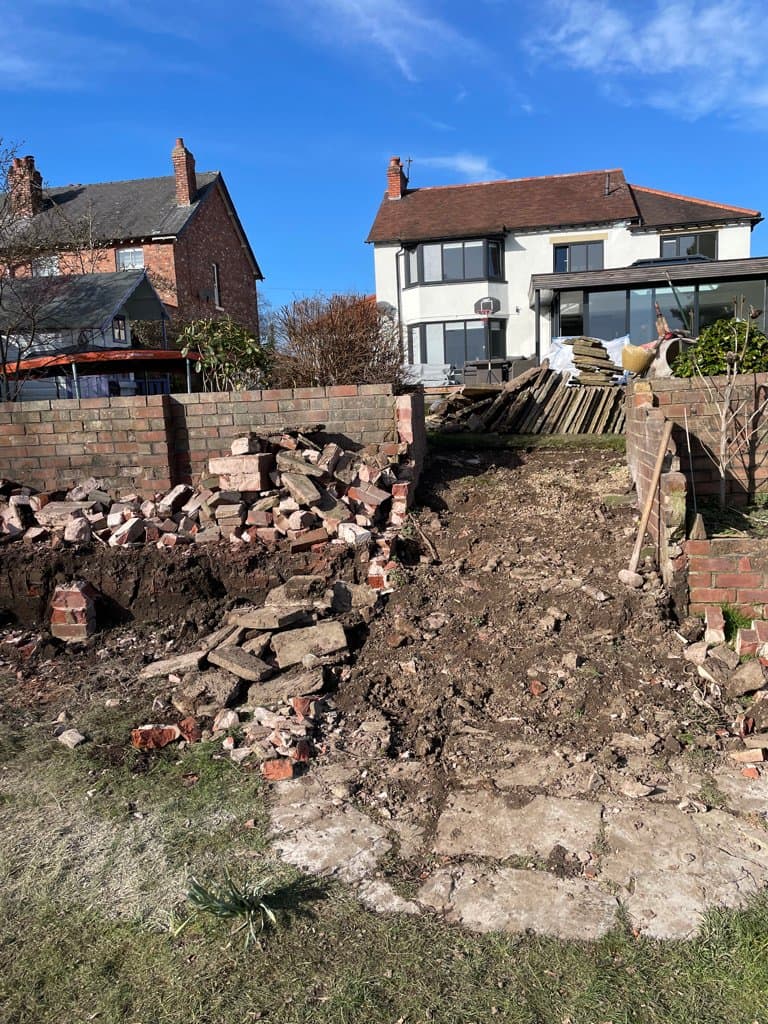
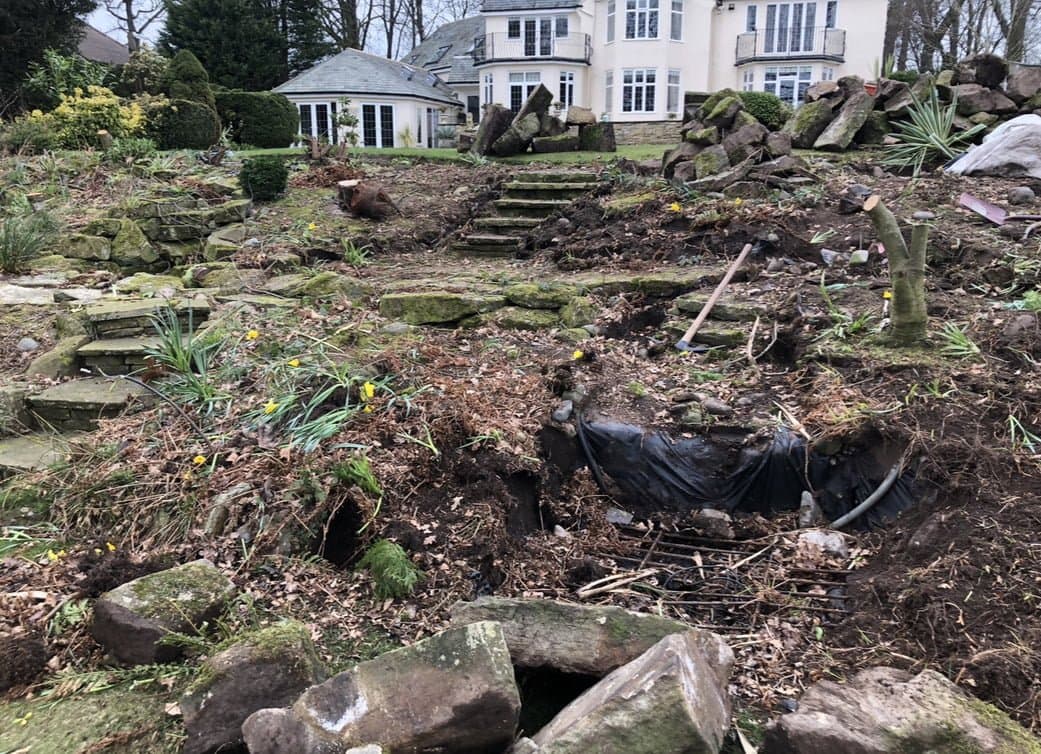
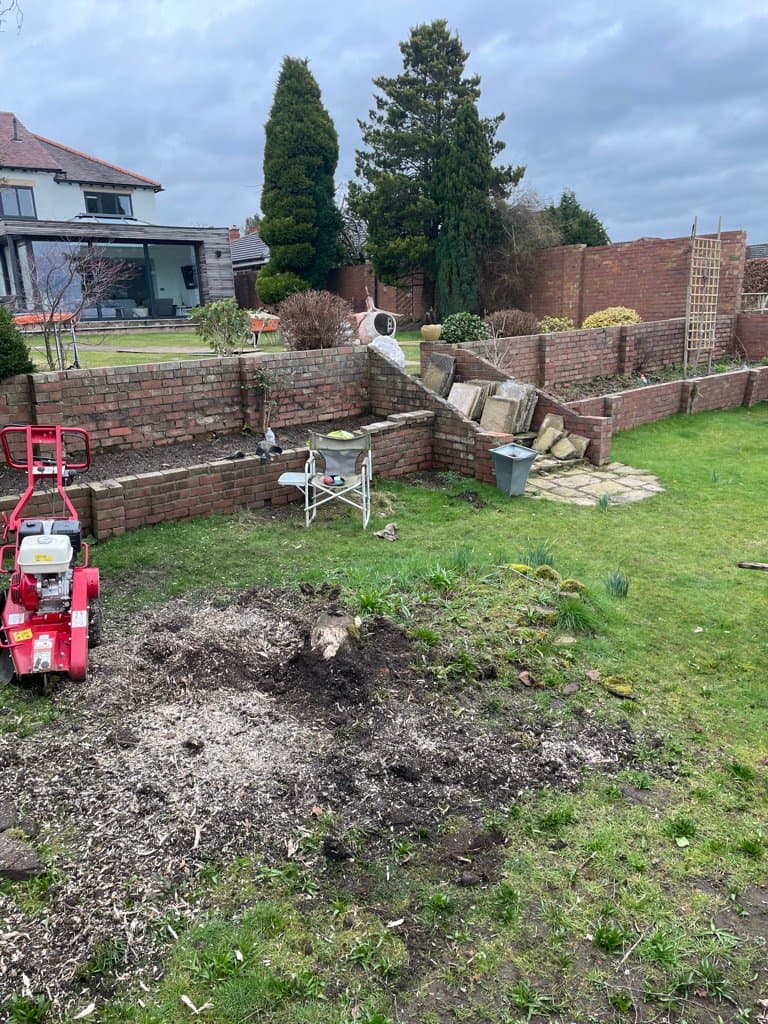
Excavation and groundwork underway for a retaining wall project on Knutsford Road, Wilmslow, where drainage was installed behind the finished structure

Garden drainage & flood prevention · Cheshire

Stop moving the water problem. Solve it properly.

Land drains, channel drains, soakaways, correct falls and complete waterlogged-lawn rebuilding across Cheshire — designed around the ground that is actually beneath your garden.

Cheshire clay does not forgive guesswork

A wet garden is rarely fixed by digging a trench and filling it with gravel. Water has to be collected, carried and discharged somewhere it can legally and physically go. If any one of those three parts is missing, the work may hide the problem for a season while quietly moving it towards the lawn, the neighbour's boundary, a retaining wall or the house.

Across Knutsford, Wilmslow, Alderley Edge, Altrincham, Macclesfield and the surrounding Cheshire towns, we regularly work on heavy clay. It absorbs water slowly, becomes easily compacted and can hold rainfall close to the surface for days. New-build gardens can be worse because construction traffic compresses the subsoil and buried rubble interrupts the natural movement of water.

We start by working out where the water comes from, how it crosses the site and where it can safely finish. Only then do we decide whether the answer is a land drain, a channel, a soakaway, corrected levels, better soil structure — or a combination of them.

Signs the problem is more than a wet winter

Some gardens are simply wet after exceptional weather. Others have a predictable fault in their levels, soil or drainage route. A site visit separates the two before money is spent.

  • Standing water remains for days after ordinary rainfall
  • A lawn stays soft, muddy or unusable through much of autumn and winter
  • Water collects against the house, garage, steps or retaining walls
  • Paving has no visible fall, or rain runs towards the building
  • Turf repeatedly dies in the same low areas
  • Borders smell stagnant or plants fail despite suitable planting
  • Water emerges at the bottom of a slope or below a neighbouring garden
  • A previous gravel trench or "French drain" fills but has nowhere to discharge

What we install

The drainage systems we install

Land drains for lawns, slopes and retaining walls

A land drain uses perforated pipe laid to a controlled fall in clean drainage aggregate, normally separated from the surrounding soil with the correct geotextile. Water enters along the pipe's length and is carried towards a suitable outfall or infiltration area.

Land drains are useful where groundwater or surface water consistently gathers across a lawn, at the foot of a slope or behind a retaining structure. The pipe is only one part of the installation. Trench depth, stone grading, filter fabric, fall, inspection access and the final discharge point decide whether it keeps working.

We do not install a pipe that finishes blindly in clay. A drain without a viable destination is only underground storage, and once it fills the original problem returns.

Channel drains beside paving, doors and garages

Linear channel drains intercept water at a hard edge: across a driveway, beside a patio, outside a garage or near a doorway. They are particularly important where existing levels leave little room to create a generous fall away from the building.

The channel still needs a correctly sized and maintainable outlet. It cannot simply empty beneath the nearest lawn. Grates should be removable, silt should be accessible for cleaning, and the finished paving must fall towards the channel rather than relying on it to collect water from a flat surface.

For patios we commonly work around a fall of approximately 1:80, adjusted for the paving, levels and site. Every surface is set to move rain away from the building while maintaining safe relationships with damp-proof courses, thresholds and adjoining ground.

Soakaways and infiltration systems

A soakaway stores rainwater temporarily and allows it to disperse into suitable surrounding ground. Modern systems often use wrapped modular crates, an upstream silt trap and correctly sized pipework rather than a hole filled with broken bricks.

They can work well in free-draining ground. They can perform badly in dense Cheshire clay if they are specified by guesswork. A larger crate does not fix soil that will not accept water: it merely takes longer to fill.

The size and position depend on the area being drained, expected rainfall, soil infiltration, groundwater, nearby structures, boundaries, trees and services. Where infiltration is unsuitable, the answer may be attenuation, a different lawful outfall or specialist drainage design rather than another soakaway.

Correcting falls and levels

Sometimes the main defect is visible above ground. A patio falls towards the house; a lawn contains an artificial bowl; a raised border sheds water across the paving; or a later extension has interrupted the garden's original drainage route.

Regrading can be more effective than adding pipework. We use surveyed or carefully established levels to create a continuous route for water, then coordinate the falls across paving, lawns, steps, channels and planting areas. The aim is not to send the water somewhere else faster. It is to control the whole journey.

Rebuilding waterlogged lawns

Repeatedly replacing turf on saturated clay wastes money. Where the soil profile is the problem, the lasting solution can involve:

  • stripping failed turf and unsuitable topsoil
  • relieving or removing compacted subsoil
  • installing land drains where a viable outlet exists
  • importing and grading suitable rootzone or topsoil
  • creating positive falls without making the lawn feel steep
  • laying premium turf only after the drainage and soil are right

The green finish is the final layer. Most of the work that makes it survive is underneath.

When is an infiltration test needed?

An infiltration test measures how quickly water enters the ground. It is important when a soakaway is being considered and the soil's ability to accept water is uncertain.

  • the site is known to contain heavy clay
  • standing water is already present
  • a new patio, driveway, roof or garden room will add runoff
  • a substantial or expensive soakaway is proposed
  • the seasonal water table may be high
  • the drainage design forms part of planning, Building Regulations or an engineer’s specification
  • failure would threaten a building, retaining wall or neighbouring property

A small trial hole can reveal obvious clay, made ground or groundwater, but it is not automatically the same as a formal infiltration test. Where a formal design or approval is required, testing should follow the specified method and be recorded properly. If the result shows that the ground drains too slowly, we say so. We will not sell a soakaway that the soil cannot support.

2026 planning ranges — not teaser prices

What garden drainage costs in Cheshire

Drainage cannot be priced honestly by the metre before the outlet, access and ground have been inspected. Ten metres of shallow channel beside an open driveway is not the same job as ten metres of land drain carried by hand through a terraced house and cut into wet clay.

Drainage within a larger project

£1,500–£4,000

Correctly formed patio falls, a modest channel run, gullies, drainage behind a wall, or a limited land-drain installation while the wider site is already excavated. Normally more economical since machinery, waste removal and reinstatement are already part of the main build.

Focused garden-drainage project

£5,000–£10,000

A realistic band for diagnosis, excavation, one or more land-drain runs, clean aggregate, geotextile, pipework, inspection or silt-control points, a viable outlet and proper reinstatement. Difficult access and deep excavation move the figure upwards.

Waterlogged lawn: drainage & rebuild

£7,500–£15,000

For a medium garden where failed turf and compacted material must be removed, drainage installed, levels corrected, rootzone imported and premium turf laid. Size, access and the depth of unsuitable ground are the largest variables.

Complex levels, soakaways or retaining work

£10,000–£25,000+

Major regrading, retaining walls, engineered drainage behind structures, formal infiltration testing, large soakaway or attenuation systems, pumped solutions, service conflicts or extensive hard-landscape reinstatement.

Our standalone construction projects normally begin around £5,000. Smaller drainage details are undertaken as part of patio, driveway and full-garden projects. Cheshire Landscape Gardener is not VAT registered, so VAT is not added to our labour or project charge; bought-in materials are priced from the supplier costs applicable to the job.

A worked example — 80m² waterlogged lawn

Consider a rear lawn of approximately 80m² on compacted clay. Water sits in two low areas, the patio discharges directly onto the grass and access is through a side passage. A proper scope might include:

  1. 1. checking levels and confirming a viable discharge route
  2. 2. lifting and disposing of the failed turf and unsuitable surface material
  3. 3. installing two correctly graded land-drain runs in clean aggregate and geotextile
  4. 4. fitting a channel at the patio edge with accessible silt control
  5. 5. correcting the lawn profile rather than leaving the same hollows
  6. 6. importing suitable rootzone/topsoil
  7. 7. laying premium turf and making good the access route

As a planning figure, that complete project would commonly sit around £9,500–£14,500, depending mainly on excavation depth, spoil volume, access and the final outlet. A cheap quotation that covers only turf replacement has not priced the cause of the failure.

Real projects

Drainage hidden inside the build

Terraced sloped garden at Mereside Road, Knutsford, with retaining structures and drainage designed behind them

Mereside Road, Knutsford

A genuinely steep garden meant water movement and stability had to be understood before the layout could be designed. The slope was divided into managed sections, retaining structures were used where the ground needed support, and drainage was designed behind them rather than left to force its way through.

Read the Mereside Road sloped-garden case study →
Two-tier garden with a natural sandstone retaining wall and porcelain paving on Knutsford Road, Wilmslow

Knutsford Road, Wilmslow

This garden had defeated a previous landscaper. We rebuilt it as two usable tiers around a substantial sandstone retaining wall. Behind the wall, drainage aggregate and a land-drain channel were installed to prevent winter water pressure building against the structure.

Read the Knutsford Road retaining-wall project →

Where the money actually goes

Investigation and levels

The route is designed before trenches are opened. Existing falls, low points, thresholds, structures, services and possible outlets all affect the solution.

Excavation and spoil removal

Wet clay is heavy, slow to handle and expensive to remove. A narrow access route can turn every tonne into wheelbarrow work — often the largest difference between two apparently similar quotations.

Clean stone, pipework and separation

Perforated and solid pipes perform different jobs. Aggregate must leave voids for water, while geotextile helps prevent surrounding fines migrating into the system. Cheap mixed rubble is not an equivalent specification.

A real destination for the water

The outlet is the job. Whether water infiltrates, enters an existing lawful surface-water system, reaches a suitable watercourse or requires attenuation must be established rather than assumed.

Reinstatement

Lawns, beds and paving must be rebuilt after excavation. Reinstatement is included in the scope rather than appearing as a surprise after the drainage has gone underground.

How it runs

How our drainage projects run

  1. Initial information

    Send the property address, several wide photographs, close-ups of the wet areas and a short description of when the problem occurs. Photographs taken during or immediately after rain are particularly useful.

  2. Site assessment

    We inspect the levels, soil, structures, access and possible destinations for water. If trial holes, a formal infiltration test, drain survey, engineer or utility search are needed, that is identified before the construction price is finalised.

  3. Written scope and quotation

    The quotation sets out excavation, materials, drainage components, spoil removal, reinstatement and exclusions, and records important assumptions rather than pricing unknowns as if they don’t exist.

  4. Groundwork first

    Drainage, levels and retaining work are completed before decorative paving, turf or planting. We work from the back of the garden outwards so finished areas are not damaged by later excavation.

  5. Handover and maintenance

    Accessible channels, gullies and silt points are shown to the client. Drains still require sensible maintenance: leaves, soil and jointing debris should not be allowed to seal the collection points.

Drainage designed for the whole garden

Drainage works best when it is coordinated with everything around it.

Frequently asked questions

Can you drain a garden built on clay?

Usually, yes — but not by pretending the clay is free-draining. The design may need to collect water and carry it to a viable outlet, improve levels and soil structure, or use attenuation rather than relying on infiltration alone. The correct answer depends on the site.

Will a French drain fix my waterlogged lawn?

Only if it is correctly constructed and has somewhere for the collected water to go. A gravel trench ending in the same clay can fill during prolonged rainfall and stop working. We establish the outlet before recommending the drain.

Can a soakaway be installed in Cheshire clay?

Sometimes, but it should not be assumed. Clay varies across short distances, and made ground or sandier layers may change the result. When viability is uncertain, infiltration testing is cheaper than installing a system that cannot empty.

How deep do garden drains need to be?

There is no honest universal depth. It depends on the source of the water, required fall, outlet level, soil profile, nearby structures and what must be reinstated above. Depth is set from the site levels, not copied from a generic diagram.

Can patio water be sent onto the lawn?

It can sometimes be directed to a sufficiently large, suitable permeable area, but not if that merely creates a permanent bog. The receiving ground and levels must be capable of handling the runoff.

Do I need planning permission?

Many private garden-drainage repairs do not require a planning application, but permissions can be relevant where work affects a listed building, protected trees, a watercourse, a sewer, a highway, neighbouring land or a larger development. Front-garden paving also has specific permeability and runoff rules. We identify when specialist or local-authority advice is appropriate rather than promising blanket permission.

Do you guarantee that a garden will never flood?

No responsible contractor can guarantee that against every storm, upstream failure or exceptional groundwater event. We design to the agreed conditions and scope, explain capacity and maintenance, and put our workmanship commitment in writing. Where the risk requires engineered calculations, we recommend that level of design.

Get a written drainage quotation.

Free, no-obligation site visits across Cheshire. A written quote, typically within 48 hours. No pressure, no hard sell — just honest advice.

07742 611273