
Blog Guide
Porcelain vs sandstone is the single most common material question we’re asked about Cheshire patios. Both are widely available, both look impressive in a supplier’s catalogue, and both sit at vaguely similar price points — until installation is factored in. In Cheshire’s clay-heavy ground and persistent North West rainfall, the practical differences between them matter more than they would somewhere drier and sandier. Here’s a direct comparison across the factors that actually determine long-term satisfaction.
Neither material is universally better. The right choice depends on your property, the garden’s context, and what you’re genuinely willing to maintain over the years ahead.
Porcelain in Wet and Frost Conditions
Porcelain is manufactured at very high temperature, producing a dense, vitrified material with water absorption typically below 0.5%. In practice, water simply can’t penetrate the slab in any meaningful quantity — there’s nothing inside it to freeze and expand, which makes correctly specified porcelain genuinely frost-proof through a Cheshire winter. Algae and moss have little to grip on its dry, non-porous surface, so growth is slower to establish and easier to remove than on stone.
Slip resistance on exterior porcelain comes down to the surface texture applied during manufacture — look for an R11 rating or above for outdoor use in Cheshire conditions. That’s a specified, testable property, not a marketing claim, and it’s worth confirming with the supplier before you commit. Smooth-finish porcelain designed for indoor use has no place on a Cheshire garden patio.
Indian Sandstone in Wet and Frost Conditions
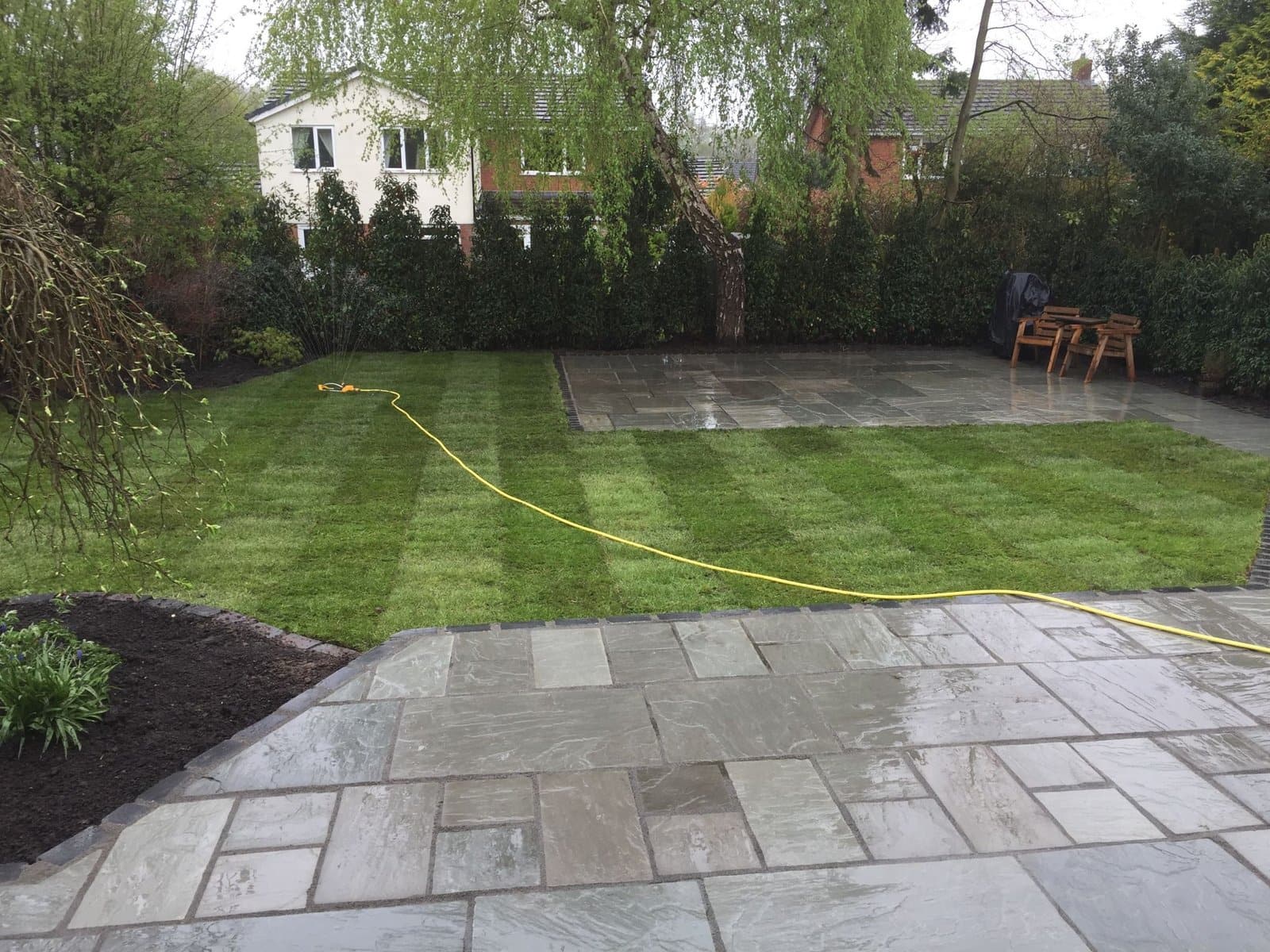
Indian sandstone is a naturally porous sedimentary stone. Water absorption varies significantly by source, grade and finish — riven surfaces are more open than honed or sawn faces — but all sandstone takes up moisture to a degree porcelain simply doesn’t. In our climate, that creates two practical risks: freeze-thaw damage when absorbed moisture expands during frost, and persistent algae and moss in shaded or north-facing gardens where the stone stays damp for extended periods.
Quality, correctly sealed sandstone manages both risks considerably better than low-grade material. Dense, well-quarried stone from a reputable supplier, sealed on installation and maintained afterwards, performs reliably in North West conditions — but the performance gap between premium and budget sandstone is real, and it’s rarely reflected in the initial price comparison homeowners make between suppliers. Riven sandstone does offer good natural grip in wet weather; an unsealed or algae-covered surface, on the other hand, becomes genuinely hazardous — arguably more so than a clean, textured porcelain surface.
Installation Specification: Where the Real Differences Lie
Both materials can be installed to a high standard, and both can be badly underspecified — the consequences of cutting corners are different for each, which is worth understanding before you compare quotes.
Sub-base requirements are identical for both materials on Cheshire clay: a compacted granular sub-base — typically 100-150mm of MOT Type 1, depending on ground conditions — laid in layers with a vibrating plate compactor, over a firm bearing stratum with soft clay removed. This is determined by the ground, not the surface material. Anyone quoting a shallower sub-base on a clay site is reducing the specification regardless of which stone they’re proposing to lay on it. Drainage falls of roughly 1:80 to 1:100 away from the house need to be established at sub-base level and carried through to the finished surface, which must sit at least 150mm below the property’s damp-proof course.
Bedding and priming is where porcelain demands more care, and the difference most likely to be skipped on a cheap quote. Sandstone is porous and bonds readily to a traditional sand-and-cement mortar bed. Porcelain’s dense, low-absorption surface needs a priming slurry applied to the back of each slab before bedding, or the bond simply fails — slabs lift or crack under load within a year or two. It’s an extra step that costs time and material, which is exactly why it’s the first thing an underpriced quote leaves out.
Realistic Costs
Material costs alone run roughly £25-£45 per m² for Indian sandstone and £45-£80 per m² for porcelain, with premium ranges above that for either. Installed cost depends far more on groundwork, drainage and access than on the raw material price — see our patio cost guide for the full breakdown.
So Which Should You Choose?
Choose porcelain if low maintenance and consistent, predictable performance through wet Cheshire winters matter most to you, particularly on a shaded or north-facing plot. Choose Indian sandstone if you want the warmth and natural variation stone brings to a period or traditional property, and you’re willing to seal and maintain it properly. Both last decades when specified and installed correctly — the material choice is about character and maintenance appetite, not durability.
Still Deciding?
We install both materials to the same rigorous sub-base and drainage standard, and we’ll give you an honest recommendation based on your specific garden rather than whichever material happens to be more profitable to sell. See our patio installation page for the full service, or get in touch for a free consultation.