
Driveway Cost Cheshire – What to Expect in 2026
Driveway cost Cheshire homeowners can expect in 2026 varies significantly depending on the material chosen, the size and shape of the driveway, ground conditions, and drainage requirements. Online cost calculators tend to quote generic national averages that don’t reflect the realities of Cheshire’s heavy clay soil, or the SUDS drainage rules that apply to almost every new or replacement driveway in the UK.
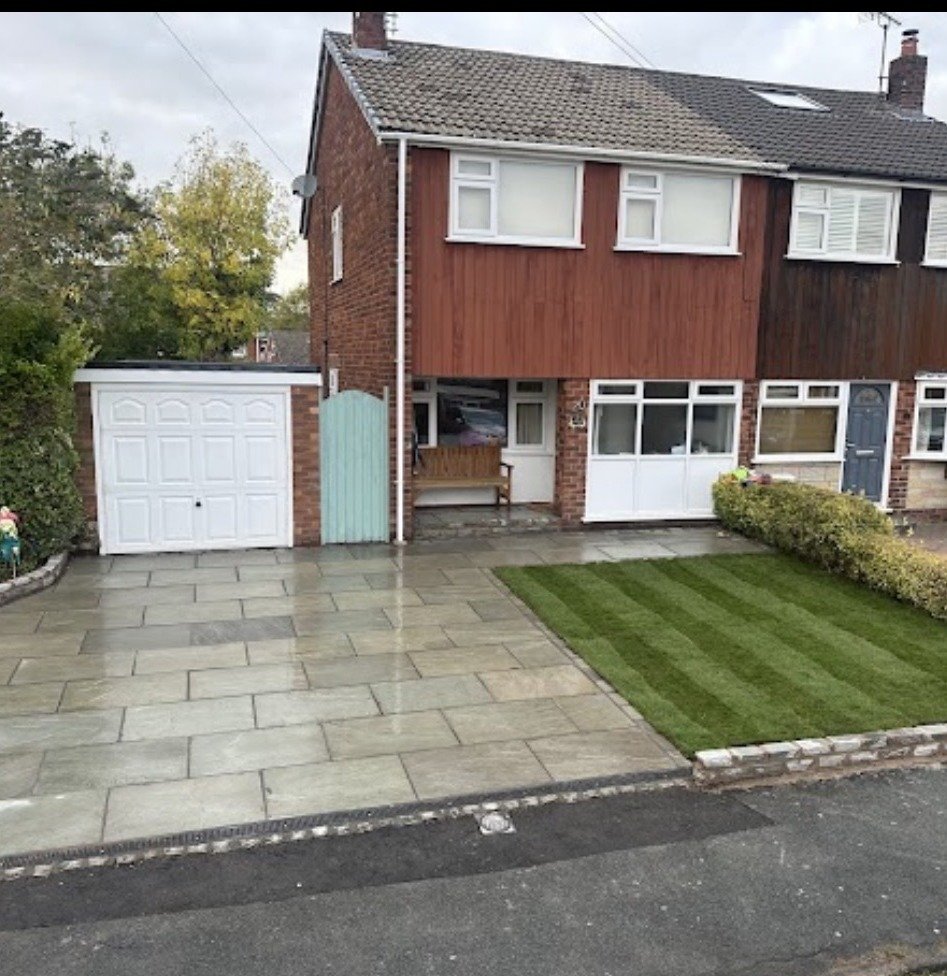
This guide sets out realistic driveway cost Cheshire homeowners should budget for in 2026, comparing the most popular surface types side by side, and explaining the ground conditions and drainage requirements that materially affect the final price. For a broader overview of landscaping costs in Cheshire, our dedicated cost guide covers the full picture across patios, driveways, fencing and lawns.
Whether you’re replacing a tired concrete drive or starting from scratch on a new-build plot, the figures below will give you a credible starting point before inviting anyone on site.
Driveway Cost Cheshire — Comparison by Material
The table below gives a working benchmark for fully installed driveway cost Cheshire projects in 2026, covering materials, sub-base, labour and standard drainage provision.
| Driveway Type | Typical Installed Cost per m² | Key Notes |
|---|---|---|
| Gravel | £120 | Cheapest option; needs edging and periodic top-up/raking. Installed price: rip out, supply, lay |
| Tarmac / Asphalt | £180–£240 | Fast to install; smooth finish; needs resealing every 5-8 years |
| Block Paving | £180 | Wide choice of colours/patterns; individual blocks repairable |
| Resin Bound | £180 | Smooth, permeable, low-maintenance, weed-resistant. Indicative installed rate only — Jason does not install resin himself; he installs premium block paving |
| Pattern Imprinted Concrete | £70–£110 | Decorative stamped finish at a lower cost than block paving |
| Indian Sandstone / Porcelain | £110–£180+ | Premium natural stone or porcelain finish; highest cost, highest kerb appeal |
These figures assume a standard domestic driveway with reasonable access and a properly specified sub-base (rip out, supply and lay). Primary hard-landscaping is over £180/m²; gravel is the exception at £120/m². Sites on heavy clay, with poor access, significant level changes, or drainage complications will sit at the upper end of each range or above it.
Material-Only Driveway Prices
The material cost is only one component of the overall spend, but it’s a useful starting point for comparison.
| Material | Typical Price per m² (excl. VAT, material only) |
|---|---|
| Gravel (sub-base and decorative aggregate) | £15–£25 |
| Tarmac | £20–£30 |
| Standard concrete block paving | £20–£35 |
| Premium/textured block paving | £35–£55 |
| Resin bound surfacing (resin + aggregate) | £35–£55 |
| Indian sandstone / porcelain paving | £30–£70+ |
Sub-base aggregate, edge restraints, membrane, and drainage components all add to the materials bill before installation begins.
Sub-Base Requirements on Cheshire Clay Soil
Much of Cheshire sits on heavy clay, which is cohesive, prone to movement with moisture changes, and drains poorly compared with sandy or chalky soils. A driveway has to withstand vehicle loading as well as weather, so the sub-base specification matters even more here than it does for a patio.
Standard guidance for driveways under vehicle loading suggests a compacted MOT Type 1 sub-base of at least 150mm for pedestrian areas, rising to 200-250mm or more for full vehicle loading on clay ground. A typical full-specification build-up for a Cheshire clay driveway:
- Excavation depth: 250–300mm below finished driveway level to accommodate sub-base, bedding and surface course
- Sub-base: 200–250mm compacted MOT Type 1 crushed stone, laid and compacted in multiple passes to prevent differential settlement under vehicle weight
- Bedding/binder course: appropriate to the chosen surface — sharp sand for block paving, tarmac binder course, or resin-bound base layer
- Edge restraints: concrete haunching or kerb edging to prevent lateral spread under vehicle loading
Under-specifying the sub-base is the most common cause of driveways that rut, sink or crack within a few years — particularly where heavier vehicles regularly use the drive.
Drainage and SUDS Compliance
Since 2008, UK permitted development rules have required that any new or replacement driveway over 5m² either uses permeable, porous, or permeable-jointed materials, or directs surface water to a lawn, border, or soakaway rather than the public drainage network. A non-permeable driveway laid without proper drainage provision technically requires planning permission.
This is a genuine practical consideration in Cheshire, where clay soil already drains poorly and heavy rainfall is common. Compliant options include:
- Resin bound surfacing, which is naturally permeable
- Permeable block paving with open joints that allow water through to a permeable sub-base
- Standard block paving, tarmac or sandstone laid with a fall directing water to a soakaway, gravel margin or rain garden rather than the highway or drain
We assess drainage requirements as part of every driveway quotation, so the design is compliant from the outset rather than something to retrofit later.
Cost Examples by Driveway Size – Cheshire 2026
The following estimates use a mid-range specification for each size, assuming reasonable site access and standard ground conditions.
Small Driveway – Approximately 30 m²
| Material | Estimated Total Cost |
|---|---|
| Gravel | £3,600 |
| Block Paving | £5,400 |
| Resin Bound | £5,400 |
| Indian Sandstone / Porcelain | £3,600–£5,700 |
Medium Driveway – Approximately 50 m²
| Material | Estimated Total Cost |
|---|---|
| Gravel | £6,000 |
| Block Paving | £9,000 |
| Resin Bound | £9,000 |
| Indian Sandstone / Porcelain | £5,900–£9,300 |
Large Driveway – Approximately 80 m²
| Material | Estimated Total Cost |
|---|---|
| Gravel | £9,600 |
| Block Paving | £14,400 |
| Resin Bound | £14,400 |
| Indian Sandstone / Porcelain | £9,400–£14,900 |
The upper end of each range assumes heavy clay ground conditions, level corrections, poor access, and additional drainage provision. Removal and disposal of an existing driveway surface will add further cost on top of these figures.
Typical Project Timelines
Timelines depend on driveway size, material, ground conditions, and — as with all groundworks in Cheshire — the weather, since sub-base compaction requires reasonably dry conditions.
- Small driveway – approximately 30 m²: 2–4 working days
- Medium driveway – approximately 50 m²: 4–6 working days
- Large driveway – approximately 80 m²: 6–10 working days, longer where excavation, drainage works or removal of an existing surface are involved
Maintenance and Lifespan
A correctly installed driveway on a properly specified sub-base should last 20-30 years or more, whatever material is chosen. Maintenance requirements vary:
- Gravel — needs periodic raking and top-up as material displaces over time
- Tarmac — benefits from resealing every 5-8 years to prevent cracking and fading
- Block paving — occasional re-sanding of joints and pressure washing; individual blocks can be lifted and replaced if damaged or stained
- Resin bound — low maintenance; occasional washing down; naturally weed and moss resistant
- Indian sandstone / porcelain — sandstone benefits from periodic sealing; porcelain needs almost none, resisting staining and frost damage
For more detail on our full driveway service, including design, materials and the process from consultation to completion, see our driveway installation Cheshire page.
Ready to Get an Accurate Quote for Your Cheshire Driveway?
Every driveway is different. Ground conditions, existing surfaces, drainage requirements, access and your choice of material all affect the final cost. The figures in this guide give you a credible starting point, but a free site visit is the only way to get an accurate, itemised quote for your specific property.
Jason Costello of Cheshire Landscape Gardener has been installing driveways and hard landscaping across Knutsford, Wilmslow, Alderley Edge, Prestbury and the wider Cheshire area for over 30 years. Every quote includes a full breakdown of materials, labour, drainage and waste disposal, so you know exactly what you’re paying for before work begins.