
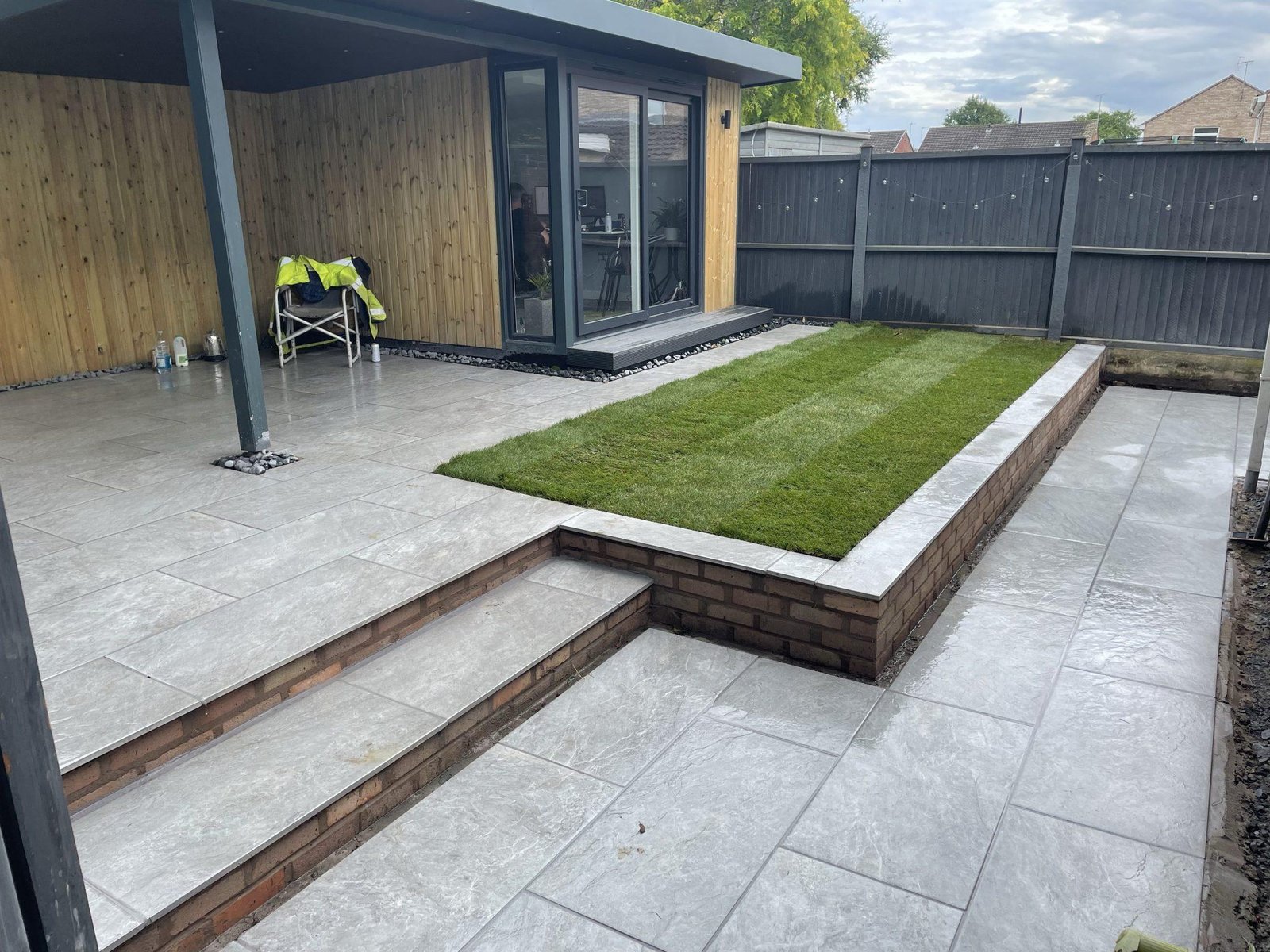
Porcelain paving Cheshire has become the most requested material across Cheshire garden projects over the past decade — and for good reason. In a county where clay soils and North West rainfall make surface water management a genuine engineering challenge, porcelain’s non-porous composition and long-term durability are practical advantages, not just marketing claims. But the material is only as good as the installation beneath it. This guide covers what a porcelain patio in Cheshire actually involves: design considerations, ground preparation for local soil conditions, drainage strategy, realistic costs, and the installation details that determine whether a project lasts 25 years or starts causing problems within five.
This page is part of our complete patio installation in Cheshire guide (https://cheshire-landscape-gardener.com/patio-installation-cheshire/), which covers all paving materials and the broader principles of patio construction across the region.
Why Porcelain Paving Performs Well in Cheshire’s Climate
Porcelain paving is manufactured at extremely high temperatures, which produces a dense, vitrified tile with very low water absorption — typically less than 0.5%. In practical terms, this means the material does not take up moisture in the way natural stone does. Water that cannot enter the slab cannot freeze and expand within it, which makes porcelain inherently frost-resistant in a climate like Cheshire’s, where temperatures regularly cycle above and below freezing through winter.
The low porosity also means porcelain resists the algae and moss growth that tends to colonise natural stone surfaces in shaded or damp gardens — a common issue in North Cheshire gardens where mature trees create persistent shade. Regular washing with water is usually sufficient to keep porcelain clean. Unlike sandstone or limestone, it does not need sealing on installation or periodically thereafter.
Exterior-grade porcelain ranges are manufactured with textured surfaces and carry slip-resistance ratings. Look for R11 or higher on the slip resistance scale for outdoor use. This is worth confirming with any supplier before purchase — not all porcelain is rated for outdoor use, and the distinction matters in Cheshire’s consistently wet conditions.
UV stability is a further advantage. Porcelain retains its colour over time without the fading or bleaching that affects some natural stones. For a garden investment expected to last decades, this consistency of appearance matters.
Preparing Cheshire’s Clay Ground for Porcelain Installation
Porcelain paving is less forgiving than thicker natural stone flags when it comes to sub-base imperfections. Its uniform thickness — typically 20mm for pedestrian paving — means any movement or unevenness in the base translates directly to the surface. This makes correct ground preparation on Cheshire’s clay soils not just important, but critical.
Excavation and Clay Removal
Before any sub-base work begins, topsoil and soft clay must be excavated to a firm, stable stratum. This is a point that cannot be compromised: attempting to build a sub-base on soft or plastic clay will result in differential settlement regardless of how well the upper layers are constructed. In gardens across Knutsford, Wilmslow, and the Cheshire Plain generally, the depth to a stable bearing layer varies — on some sites it is shallow, on others significantly deeper, particularly where there has been previous garden construction, root disturbance from mature trees, or filled ground.
Sub-Base Depth for Clay Sites
Standard residential patio sub-base specification — 100–150mm of compacted granular material (MOT Type 1) — is adequate for free-draining ground. On Cheshire clay, the specification increases to 150–200mm of compacted granular material. The additional depth serves two purposes: it spreads the structural load more broadly across the clay beneath, and it creates a more stable platform less susceptible to seasonal clay movement.
Clay shrinks in dry conditions and swells when wet. Over a year, this movement can be several millimetres — sufficient to cause cracking in rigid jointing compounds and lippage between adjacent slabs if the sub-base depth is inadequate. In areas of Cheshire with particularly active shrinkable clay, geogrid reinforcement layers within the sub-base provide additional bearing capacity and reduce the risk of differential settlement across large patio areas.
Compaction must be carried out in 75mm layers using a vibrating plate compactor. Compacting the full depth in one pass is ineffective — the lower layers remain loose and will settle under load. Any soft spots identified during compaction need to be excavated and properly consolidated before build-up continues.
Total excavation depth for a typical porcelain patio on Cheshire clay is approximately 250mm: 20mm porcelain slab + 30–50mm mortar bed + 180–200mm compacted sub-base. This is deeper than many homeowners expect, and it is the reason why professional patio installation in Cheshire (https://cheshire-landscape-gardener.com/patio-installation-cheshire/) costs more than a surface-level price comparison might suggest.
Drainage Design for North West Rainfall
Porcelain’s non-porous surface means all rainfall landing on it must be actively managed — it will not absorb into the paving, and on Cheshire’s clay ground, it cannot reliably soak away through the sub-base either. A clear drainage strategy is not an optional extra on a porcelain patio installation; it is a core part of the design.
Surface Falls
The patio surface should fall consistently away from the house at a gradient of 1:80 to 1:100. At this gradient, water moves freely across the surface without creating the noticeable slope that feels uncomfortable underfoot. The sub-base must be constructed with the same fall so that any water penetrating the bedding layer also drains away in the correct direction. Setting falls correctly at sub-base level is the right approach — attempting to adjust them in the bedding layer creates inconsistent bed depths and uneven surfaces.
The finished surface must also sit at least 150mm below the building’s damp proof course. Splashback from hard surfaces is a known cause of moisture ingress in older Cheshire properties, and the clearance between paved surface and DPC is both a best-practice requirement and a practical protection for the building fabric.
Managing Water on Clay
On clay-dominant ground — which covers the majority of Cheshire gardens — traditional soakaway drainage is generally ineffective. Clay’s infiltration rate is too slow to accept water at the rate it arrives during a North West rainfall event. Water that cannot soak away backs up, saturates the sub-base, and creates the conditions for frost damage, base failure, and surface movement.
The appropriate approach on clay is a managed drainage system: a linear channel drain or perimeter French drain collecting surface water and directing it to a suitable discharge point — storm drain, watercourse, or an attenuation feature in the wider garden. Where falls towards the house or site boundary cannot be avoided, edge channel drains become essential rather than optional. On larger Cheshire garden projects, swales and attenuation ponds increasingly form part of the drainage strategy, particularly where planning conditions apply.
Porcelain vs Indian Sandstone: Performance in Cheshire Conditions
The majority of homeowners comparing materials are choosing between porcelain and Indian sandstone. Both are widely available through Cheshire suppliers, both look attractive in design imagery, and both appear at similar price points at the supply-only level. Their performance in use differs considerably.
Moisture and Frost Resistance
Porcelain’s near-zero water absorption makes it inherently frost-resistant. Indian sandstone is porous — the degree varies significantly by source and grade, but most imported sandstone absorbs moisture into its structure. In Cheshire’s freeze-thaw winters, moisture within the stone expands on freezing, causing spalling, surface flaking, and accelerated weathering over time. Quality, correctly sealed sandstone manages this better than low-grade material, but it requires ongoing maintenance that porcelain does not.
Maintenance Requirements
Porcelain requires no sealing. Indian sandstone should be sealed on installation and re-sealed periodically — typically every two to three years, depending on exposure. In shaded Cheshire gardens, unsealed or poorly maintained sandstone will develop persistent algae and moss growth. The annual maintenance cost of a sandstone patio over ten years is a real consideration in whole-life cost comparisons.
Aesthetics and Design
Natural stone offers variation, character, and a warmth that manufactured materials cannot fully replicate. For period Cheshire properties — older farmhouses, Victorian and Edwardian homes in Knutsford’s conservation areas, or the traditional village properties found across Mobberley and Alderley Edge — sandstone or limestone often integrates more sympathetically into the architecture. Porcelain suits contemporary builds and modern garden designs well, and the range of finishes now available — including convincing stone and slate effects — has expanded considerably.
Cost Comparison
Supply-only material costs are broadly comparable at the mid-range: quality Indian sandstone from approximately £25–£45 per square metre; mid-range outdoor porcelain from £45–£50 per square metre, rising to £80 per square metre or above for premium collections. The installation cost difference is less significant than the material cost difference suggests — porcelain requires specialist cutting equipment and more precise bedding work, while sandstone is more tolerant of minor sub-base variation but requires sealing on completion. Over a 15–20 year period, porcelain’s lower maintenance requirement typically offsets the higher material cost for most Cheshire homeowners.
The Porcelain Patio Installation Process
A properly installed porcelain patio in Cheshire follows a sequence that cannot be significantly shortened without compromising the result.
Site survey and design come first: confirming ground levels, DPC clearance, drainage options, and the fall direction available. On many Cheshire garden projects, particularly in areas with established landscaping, mature trees, or existing structures, this survey stage identifies complications that affect the specification before any work begins.
Excavation follows: removing topsoil and soft clay to a stable bearing layer, with all excavated material removed from site. Sub-base material is then installed in compacted layers of 75mm, building to the full 150–200mm depth required on clay ground. Each layer is compacted thoroughly before the next is added.
Drainage elements — channel drains, edge restraints, any perimeter French drain — are installed and connected to the discharge point before the bedding layer is placed. Falls are set and confirmed at sub-base level.
Porcelain is laid on a full mortar bed — spot bedding is not appropriate for this material and leads to cracking under point loads. The mortar mix must be compatible with porcelain’s low porosity; standard sand and cement without an SBR additive or polymer primer can result in adhesion failure. Many quality porcelain installations use a flexible adhesive bed rather than traditional mortar, particularly for premium slabs.
Jointing uses a specialist flexible grout or polymeric jointing compound rather than rigid mortar. Porcelain expands slightly with temperature variation; rigid joints crack. Movement joints should be incorporated at intervals and at abutments with the house wall.
Edge haunching in concrete secures perimeter slabs and prevents lateral spread of the patio over time.
Most manufacturers, including suppliers such as Bradstone, publish technical installation guidance that should be followed alongside ground preparation best practice.
Cost Guidance for Porcelain Patio Installation in Cheshire
Material costs for porcelain paving range from approximately £45–£50 per square metre for good mid-range outdoor collections, to £80 per square metre and above for premium ranges. These are supply-only figures.
Installed project costs are substantially higher when sub-base, excavation, drainage, bedding, labour, jointing, edge restraints, and waste removal are included. A comparable local installer — Goodwin Gardens, covering South Cheshire — publishes installed costs in the region of £180–£200 per square metre for typical projects, with complex layouts or premium materials at the higher end. This figure is broadly consistent with what quality installation commands across Cheshire generally, though site-specific factors — ground conditions, access, drainage complexity, and project size — all affect the final cost.
Homeowners comparing quotes should ensure like-for-like specifications: sub-base depth, drainage provision, jointing method, and what is included in waste removal. A lower quote that omits engineered drainage on a clay site, or specifies a shallower sub-base, is not a saving — it is a deferred cost.
A realistically specified porcelain patio on Cheshire clay, including full drainage provision, should be viewed as a 20–30 year investment. The cost of remediation — excavating a failed patio, disposing of materials, and relaying to a correct specification — typically exceeds what was saved by under-specifying the original installation.
When properly specified, porcelain paving Cheshire installations should last 20–30 years without structural failure.
Common Installation Mistakes That Cause Porcelain Patio Failure
Insufficient sub-base depth on clay. The most common cause of settlement, rocking slabs, and joint failure across Cheshire installations. Clay ground requires 150–200mm of compacted granular base — not the 100mm adequate on free-draining soils.
Spot bedding instead of full mortar bed. Porcelain laid on dabs of mortar rather than a continuous bed has unsupported areas that crack under point loads — furniture legs, foot traffic, dropped objects. Full bed installation is not optional for this material.
Rigid jointing on porcelain. Standard mortar joints in porcelain paving crack as the material expands and contracts with temperature. Polymeric or flexible grout is the correct specification.
Falls set incorrectly or absent. A patio laid flat or falling towards the house is a drainage failure waiting to happen. Falls must be designed in, not left to chance during laying.
No DPC clearance check. Finishing a patio within 150mm of the house DPC creates a splashback risk that can cause damp internally — particularly in older Cheshire properties with lower DPC levels.
No edge restraint. Without concrete haunching at the perimeter, slabs migrate laterally over time, opening joints and destabilising the surface from the outside in.
Using standard mortar without primer on low-porosity porcelain. Standard cement-based mortar relies partly on absorption into the material for adhesion. Porcelain’s near-zero absorption means this bond is weak. SBR bonding agent or specialist adhesive mortar is required for a reliable bed.
Frequently Asked Questions
Is porcelain paving slippery when wet?
Exterior-grade porcelain paving is manufactured with textured surfaces specifically designed for wet conditions and carries a slip-resistance rating — look for R11 or above for outdoor use in Cheshire’s wet climate. Not all porcelain carries an outdoor slip rating, so this should be confirmed with the supplier before purchase. Correctly specified exterior porcelain is not inherently slippery and performs reliably in wet conditions.
Does porcelain paving need sealing?
No. Porcelain’s near-zero water absorption means sealing is not required and provides no practical benefit. This is one of its key advantages over natural stone in Cheshire’s climate — there is no periodic resealing cost and no risk of staining from inadequate or missed maintenance. Cleaning with water and a mild detergent is sufficient for routine maintenance.
How much does a porcelain patio cost installed in Cheshire?
Material costs for outdoor porcelain run from approximately £45–£80 per square metre depending on the range selected. Installed project costs in Cheshire — including excavation, clay-appropriate sub-base, drainage, labour, jointing, and waste removal — typically fall in the region of £150–£200 per square metre for quality installation. Site-specific factors including ground conditions, drainage complexity, access, and project size all affect the final figure. Accurate pricing requires a site assessment.
Why does my porcelain patio crack or have rocking slabs?
Cracking and rocking in porcelain paving are almost always caused by sub-base problems rather than material failure. The most common causes in Cheshire are insufficient sub-base depth for clay ground conditions, inadequate compaction, soft spots where unstable clay was not fully removed, or spot bedding rather than a full mortar bed. Rigid jointing compounds that have not accommodated thermal movement also crack over time. Repair of these issues requires excavation to sub-base level — surface-only remediation does not address the underlying cause.
Can porcelain paving be installed over an existing concrete patio?
In some circumstances, yes — but only if the existing concrete base is structurally sound, level, and has no significant cracking, movement, or drainage problems. Installing over a failing concrete base transfers those problems to the new surface. Any drainage deficiency in the existing base also needs to be resolved before overlaying. Where the existing base is suspect or the drainage is inadequate, full removal and reinstatement to the correct specification for Cheshire’s ground conditions is the more reliable approach.
If you’re planning a porcelain patio in Cheshire and want it built to the correct ground specification for clay soil and North West drainage conditions, we’re happy to provide a site-specific assessment.