
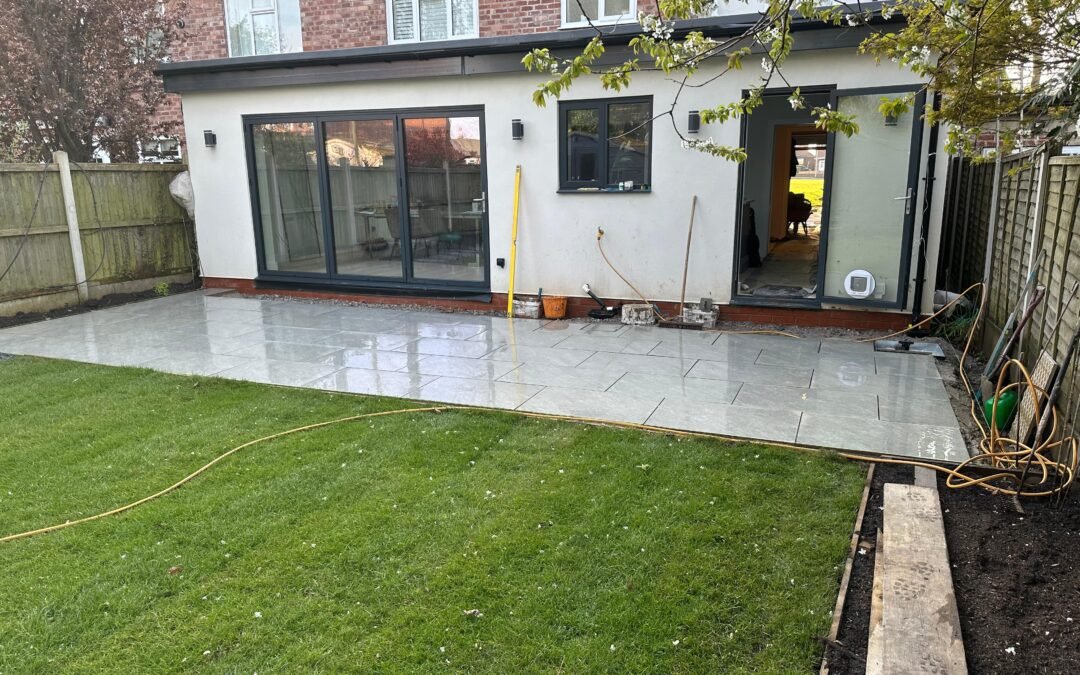
Patio installation in Cheshire requires more than choosing attractive paving slabs. Across Knutsford, Wilmslow, Alderley Edge and Prestbury, most gardens sit on heavy clay soils and experience significant North West rainfall. That combination changes how patios must be designed and constructed if they are to remain level, stable and free-draining for decades.
This guide explains what separates a professionally engineered patio from one that begins to move or sink within a few seasons. We cover clay ground preparation, sub-base depth, drainage design, porcelain versus natural stone performance, typical cost considerations and the most common causes of failure. Whether you are replacing an ageing patio or planning a new outdoor space, understanding the groundwork is what protects your investment long term.
Patio & Paving in Cheshire – What Makes It Different?
Cheshire ground conditions are the defining factor in patio performance. The majority of residential plots across Knutsford, Wilmslow, Alderley Edge and surrounding villages sit on clay-dominant soil profiles. Clay drains slowly and expands when wet, then contracts during prolonged dry spells. Over time, that movement can be enough to disturb any patio built on inadequate foundations.
Unlike sandy or free-draining soils, clay cannot be relied upon to absorb surface water efficiently. A patio installation in Cheshire must therefore manage water deliberately, directing it away from the house and preventing saturation of the sub-base. Ignoring this reality is one of the most common reasons patios fail locally.
Access constraints also influence build quality. Many Cheshire properties have narrow side access, mature trees, existing landscaping or low damp proof course levels. These site-specific factors should be assessed before levels are set or excavation begins. A patio should be engineered around the property — not forced into it.
Patio Design Considerations for Cheshire Homes
Design and engineering must work together. In newer estates around Wilmslow or Prestbury, modern architecture often pairs well with clean-lined porcelain paving, integrated lighting and defined entertaining zones. In period properties across Knutsford or Alderley Edge, natural stone may integrate more sympathetically with traditional brick and stonework.
Functional zoning is increasingly important in Cheshire gardens. Dining areas, seating zones, outdoor kitchens and fire features should be planned with adequate drainage and fall from the outset. Retrofitting drainage around built-in features later is disruptive and costly.
Lighting, raised planters and retaining features also affect structural design. Raised beds add lateral pressure; integrated seating alters loading patterns; pergolas and outdoor kitchens require additional base stability. These considerations influence excavation depth and sub-base specification long before surface materials are laid.
Preparing Clay Soil Properly Before Installation
The most critical stage of patio installation in Cheshire happens before any slab is visible. All soft topsoil and unstable clay should be removed until a firm bearing stratum is reached. Building directly onto plastic clay is a reliable route to settlement.
On clay-heavy sites, sub-base depth typically increases to 150–200mm of compacted MOT Type 1 granular material. This exceeds the standard 100–150mm used on free-draining soils. The additional depth distributes load and reduces the impact of seasonal clay movement.
Compaction should be carried out in thin layers, generally no more than 75mm at a time. Any soft pocket left within the sub-base will translate into future movement at surface level. Where bearing capacity is particularly poor — often following tree removal or previous construction disturbance — geogrid reinforcement within the sub-base can significantly improve stability.
Total excavation depth on clay sites commonly reaches 220–250mm once slab thickness and bedding layers are accounted for. Reducing that depth to cut costs is false economy.
Drainage Strategy for North West Rainfall
Cheshire experiences higher annual rainfall than much of England. Water management is therefore a structural requirement, not a finishing detail. Patio surfaces should fall away from the property at approximately 1:80 to 1:100, with the sub-base constructed to the same gradient.
Finished patio level should remain at least 150mm below the damp proof course. This protects the building fabric from splashback and moisture ingress — a critical consideration on older Cheshire properties.
Traditional soakaways are often ineffective in heavy clay soils. Instead, drainage solutions typically involve controlled discharge systems such as linear channel drains, lined permeable systems or French drains where surface falls alone cannot achieve adequate water removal. Larger garden transformation projects may incorporate swales or attenuation features as part of a broader water management strategy.
A patio that drains correctly will resist frost damage, reduce algae formation and protect the sub-base from saturation. A patio that traps water will deteriorate predictably.
Porcelain vs Natural Stone in Cheshire’s Climate
Porcelain Paving
Porcelain paving is dense, non-porous and highly resistant to moisture absorption. In wet Cheshire conditions, this provides excellent resistance to staining, frost damage and algae growth. Most outdoor porcelain ranges offer textured, slip-resistant finishes suitable for year-round use.
Material costs typically range from £45–£80 per m² depending on quality and finish. Porcelain requires precise installation and cutting with specialist equipment, making sub-base accuracy even more important.
Natural Stone
Natural stone — including Indian sandstone, limestone, slate and granite — offers variation and character that complements many traditional Cheshire properties. However, most stones are porous and require sealing to manage moisture and staining.
Indian sandstone generally ranges from £25–£45 per m² for materials, while premium stones such as granite may exceed £90 per m². Higher-grade stones perform significantly better in wet climates than lower-cost imports.
The right choice depends on architectural style, maintenance expectations and budget. Both materials perform exceptionally when installed on properly engineered groundwork.
For a deeper look, see our porcelain paving in Cheshire guide
Common Patio Failures in Cheshire
Settlement and rocking slabs almost always indicate insufficient sub-base depth or poor compaction. The slab has not failed — the foundation beneath it has moved.
Standing water results from incorrect falls or inadequate drainage provision. Prolonged surface water accelerates frost damage and undermines joints.
Joint failure occurs when movement or freeze-thaw cycles compromise mortar or jointing compounds, allowing water penetration into bedding layers.
DPC bridging happens when finished levels are too high against the property, increasing risk of damp ingress.
Lack of edge restraint allows slabs to migrate laterally, opening joints and destabilising the surface.
Each of these failures is preventable through correct specification at the outset.
Investment Guidance for Patio Projects in Cheshire
Material supply costs typically range from:
- £15–£30 per m² for quality concrete slabs
- £25–£45 per m² for Indian sandstone
- £45–£80 per m² for porcelain
- £90+ per m² for premium natural stone
Total installed project costs depend on excavation depth, drainage requirements, site access and design complexity. Clay ground conditions in Cheshire often increase groundwork requirements compared to lighter soils elsewhere in the UK.
A professionally engineered patio should provide 20–30 years of service life. Installations built on reduced sub-base depth or inadequate drainage frequently require remedial work within 5–10 years, often at greater cost than building correctly the first time.
Why Professional Patio Installation Matters in Cheshire
Everything that determines long-term performance — excavation depth, compaction, drainage gradient, DPC clearance and edge restraint — becomes invisible once slabs are laid. In Cheshire’s clay conditions, small errors magnify over time.
With over 30 years of experience working across Knutsford, Wilmslow, Alderley Edge, Prestbury and surrounding Cheshire villages, we understand how local ground conditions behave through seasonal cycles. That knowledge informs how we specify sub-bases, manage drainage and set levels to protect both the patio and the property itself.
A patio installation in Cheshire should not simply look impressive on completion day — it should remain stable and level for decades.
Patio Installation Services Across Cheshire
We design and install patios throughout Knutsford, Wilmslow, Alderley Edge, Prestbury and across Cheshire. From contemporary porcelain entertaining areas to traditional sandstone terraces and full garden transformation projects, every installation is engineered for local ground conditions and rainfall patterns.
If you are planning a new patio or replacing an existing surface, we provide detailed site assessments, clear specifications and long-term construction standards that protect your investment.
Frequently Asked Questions
How deep should a patio base be on Cheshire clay?
On clay soils typical of Cheshire, 150–200mm of compacted granular sub-base is recommended, compared to 100–150mm on lighter soils. Total excavation depth including bedding and slab thickness usually reaches 220–250mm.
Is porcelain better than sandstone in wet climates?
Porcelain is non-porous and highly resistant to moisture and frost, making it well suited to Cheshire’s rainfall. High-quality natural stone also performs well when properly sealed and maintained.
Do I need drainage channels on my patio?
Where surface falls alone cannot direct water safely away from the property, linear drainage channels or French drains are advisable, particularly on clay soils.
Does a patio require planning permission in Cheshire?
Most patios fall under permitted development, but conservation areas and listed properties may require consent. Always verify with the relevant Cheshire authority if uncertain.
How long should a properly built patio last?
A correctly engineered patio installation in Cheshire should provide 20–30 years of service without major structural issues when built on adequate sub-base and drainage foundations.