
Luxury garden transformations Cheshire begin below ground — and that is what separates work that lasts from work that fails. Every project we deliver starts several hundred millimetres beneath the finished surface, with engineered drainage, compacted sub-base, and a specification matched precisely to the site’s ground conditions. The premium materials, permanent structures, and design intent layered on top of that foundation are only as good as what supports them. In Cheshire’s specific conditions — clay-heavy soils that shrink and swell with the seasons, and North West rainfall among the highest in England — engineering this foundation correctly is not optional. It is the difference between a garden that holds its level, drains without intervention, and looks as considered in fifteen years as it did on completion, and one that settles, opens at the joints, and demands remedial work within a few seasons.
What follows covers our design and build approach, the project types we deliver across Cheshire and the North West, the materials and structures we specify, and what realistic investment in high-end landscaping in Cheshire actually looks like.
Luxury Garden Transformations Cheshire: Investment Expectations
The word luxury is applied freely in landscaping. In practical terms, what it should mean is this: a garden designed specifically for its site — its ground conditions, its drainage profile, its relationship to the building — and built to a standard where every element is specified correctly and installed with the precision that makes it last. Luxury garden design in Cheshire is not a collection of premium materials assembled quickly and expensively. It is a considered, engineered outdoor space where the design decisions and the construction decisions are made by the same team, to the same standard, from first survey to final handover.
Cheshire presents specific challenges that any landscaper working here needs to understand before they price a project, let alone begin one. Clay soils dominate from Knutsford and Wilmslow south through Macclesfield and Nantwich. Clay shrinks in a dry summer and swells after autumn rain — movement that will open joints, shift slabs, and disrupt any hard landscaping built without adequate depth and compaction beneath it. North West rainfall means that surface water management is a design requirement, not an afterthought. A patio that floods or holds standing water is a failure, regardless of the quality of the stone on top.
Our approach is to design once and build properly. Every project begins with a site survey that establishes ground conditions, existing drainage, DPC levels, access constraints, and the relationship between the garden and the building. The specification that follows addresses those conditions directly. The result is a garden that does not require remedial work because the construction beneath it was adequate from the start. This engineering-first methodology is what defines luxury garden transformations in Cheshire when they are done to a standard that endures.
Signature Project: Church Green, Lymm
Commercial-Level Precision for Outdoor Hospitality
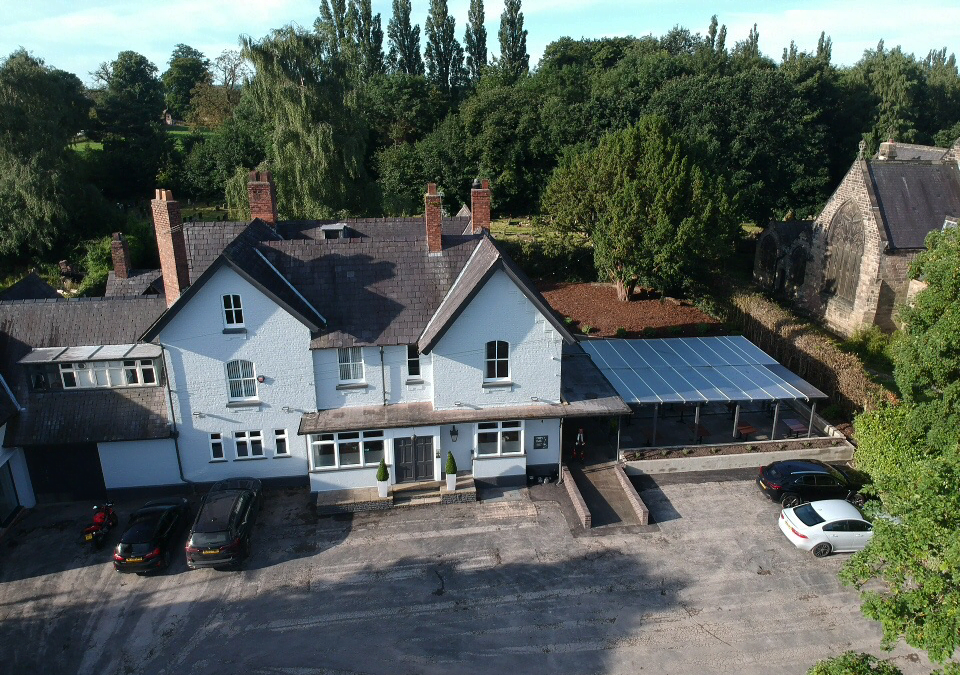
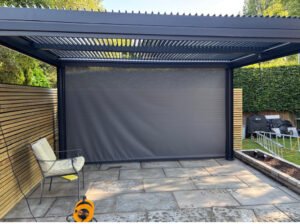
The Church Green project in Lymm represented a scale and complexity more commonly associated with commercial hospitality than residential landscaping. A large-format Sandstone terrace forming the centrepiece of an outdoor dining and entertaining space, anchored by a multi-bay wooden structure engineered for permanence, weather protection, and year-round use.
A recent commercial garden transformation at Church Green, Lymm — from derelict pub exterior to finished patio with pergola and festoon lighting.
Large-format sandstone at this scale — slabs beyond the standard 900 x 600mm formats — demands full-bed installation on a mortar base of absolute consistency. Any variation in bed depth translates directly into lippage between adjacent slabs, which is both a trip hazard and an aesthetic failure on a project of this standard. The sub-base beneath was engineered to the depth required by Lymm’s ground conditions, with falls established at formation level and maintained through every subsequent layer.
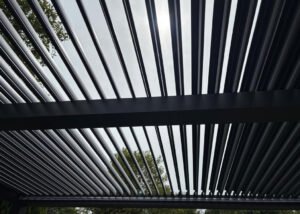
The wooden pergola in Cheshire installations of this calibre requires engineered concrete footings designed for the span and wind load of the installation. The integration between the structure’s drainage — managing rainfall from the louvred roof — and the terrace drainage below was designed as a single system, not two separate elements bolted together. The result is a terrace that handles Cheshire’s rainfall without pooling, without redirecting water toward the building, and without the jointing failures that occur when drainage is an afterthought.
Projects like Church Green demonstrate what commercial-level precision looks like when applied to private and hospitality outdoor spaces. The management requirements — sequencing trades, coordinating structure installation with paving, ensuring electrical integration is properly protected — are the same regardless of whether the client is a restaurant or a homeowner investing at that level. This level of coordination and structural integration defines what garden design and build in Cheshire should achieve when executed to the highest standard. Patio & paving in Cheshire
Signature Project: Manchester Road, Wilmslow
From Groundworks to a Modern Entertaining Space
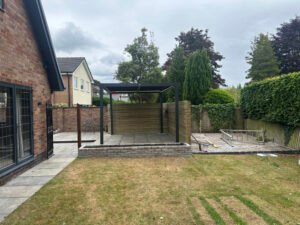
A full transformation of a modern executive garden in Wilmslow — taken from bare groundworks and a working construction site through to a porcelain-paved entertaining space, finished with a timber pergola, contemporary Venetian slatted fencing and integrated planting.
A recent garden transformation at Manchester Road, Wilmslow — from groundworks to the finished porcelain patio and pergola.
★★★★★
“We have just completed our garden project with Jason and absolutely love the final result! He was very personable, super flexible and responsive, and listened carefully to our needs — designing the plan around them and adapting as new ideas appeared. Incredibly skilled work, from the rebuilt retaining wall and flag laying to the Venetian fencing and pergola. We’re now spending all the time we can in the garden and are so grateful for what he’s done.”
— Lauren Gupta, Google review (5★)
More Recent Transformations
A Few More Cheshire Gardens
Blackhill Lane, Knutsford — tired lawn to a finished patio and garden.
Willow Green — a full garden transformation, from neglected to loved.
Authority Project: Bucklow House
Estate-Scale Infrastructure Beneath a Premium Finish
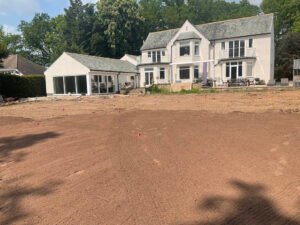
Precision groundworks and level setting across a large-scale residential garden project.
Bucklow House represents the category of Cheshire projects where the scale of groundworks and drainage engineering is as significant as any surface element. Large private properties on Cheshire’s heavier clay soils — and Bucklow sits in exactly this category — present drainage challenges that cannot be resolved with surface falls alone. The water volumes involved, and the clay’s resistance to infiltration, require a designed drainage strategy that treats the whole site as a hydraulic system.
The transformation involved major excavation across a large footprint: removing soft clay to stable bearing strata, constructing a sub-base of the depth and specification that clay ground demands, and establishing a drainage network that collected and discharged surface water at a controlled rate. Curved lawn formation at this scale requires precise groundwork — the finished grass surface follows a geometry that was established in the soil profile below it, not applied afterwards.
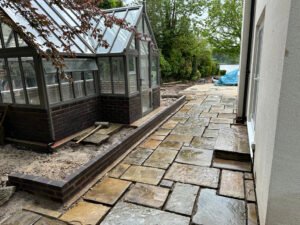
Finished Yorkstone terrace with brick retaining details and lakeside backdrop.
Hard landscaping at estate scale involves the same principles as a smaller project, applied consistently across a much larger area. Consistent falls. Consistent compaction. Edge restraints that hold the geometry of the paved areas over time. The premium finish — the quality of the stone, the precision of the cuts, the alignment of the joints — is visible from the first day. The engineering beneath it is what ensures that finish is still intact in twenty years.
Country and estate gardens require infrastructure, not just surface materials. The investment in that infrastructure is what separates a garden that ages well from one that begins to fail within a few seasons of completion. This depth of clay soil expertise and drainage authority is what distinguishes projects built to last from those that require remedial intervention before their first decade is complete. Porcelain Paving in Cheshire
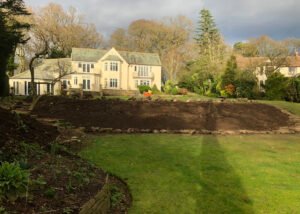
Precision groundworks and level setting across a large-scale residential garden project.
Modern Executive Garden: Chestnut Drive
Precision Landscaping for Contemporary Architecture
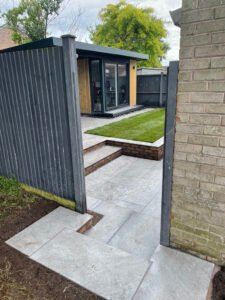
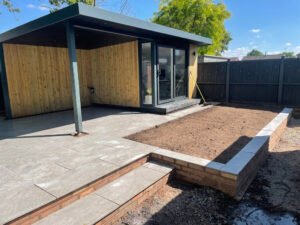
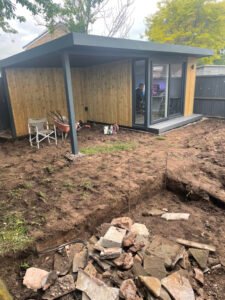
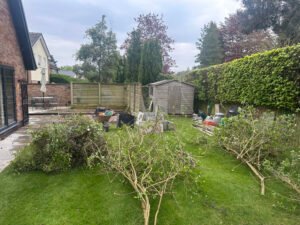
Before picture of total chaos
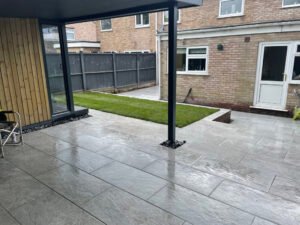
Contemporary properties across Cheshire — the executive builds in Wilmslow, Alderley Edge, and Prestbury that define the county’s modern residential landscape — demand a different design language from traditional stone-and-planting gardens. Clean geometry. Hard edges. Defined zones with clear transitions between them. Materials and lines that complement the architecture rather than contrast with it.
The Chestnut Drive project involved the integration of a garden room structure with a porcelain patio in Cheshire’s characteristic clay conditions, managing the threshold between internal and external space as a designed detail rather than a practical necessity. Where a garden room meets a paved terrace, the junction must account for the DPC of the structure, the drainage fall of the paving, and the visual continuity of the finished floor level — three requirements that occasionally conflict and must be resolved in design before any construction begins.
Stepped detailing in porcelain requires the same precision as level paving, with the additional complexity of nosing profiles, riser heights, and the structural requirement that each step is independently supported and cannot move relative to its neighbours. Brick retaining walls defining the garden’s levels were built to the same quality standard as the surface elements — not as utilitarian structures hidden by planting, but as visible design features in their own right.
The garden is divided into defined outdoor zones — dining, circulation, planting — each with a clear purpose and a clear relationship to the others. Modern architecture requires precision landscaping. Approximate geometry and casual alignment are visible immediately on a contemporary project in a way they might not be on a more informal traditional garden.
Transformation Story: Lakeside, Lymm
Luxury Fails Without Proper Foundations
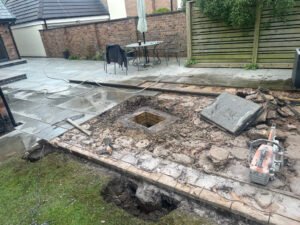
Ground work !!!
The Lakeside project in Lymm is the clearest demonstration of what clay soil and drainage challenges look like in practice — and why addressing them properly is the prerequisite for everything else. The site presented significant clay movement issues and a drainage profile that, without intervention, would have resulted in standing water across the main terrace area and progressive settlement of any hard landscaping installed without deep enough foundations.
The excavation phase established the extent of the problem — soft clay extending to a depth that required removal and replacement before a sub-base of adequate bearing capacity could be constructed. This is not unusual on Cheshire sites, but the depth required here was at the higher end of what residential projects typically encounter. The sub-base was built to 200mm of compacted MOT Type 1 granular material, in layers, with compaction confirmed at each stage before the next was added.
Drainage was designed as a complete system: surface falls on the terrace directing water to channel drains, those channel drains connected to a managed discharge route away from the building and away from the clay subsoil that would not accept infiltration at a useful rate. The aluminium pergola’s integrated drainage connected into the same system, preventing the structure from becoming a source of concentrated water discharge onto the terrace surface.
The multi-level porcelain terrace that sits on top of this foundation — the element visible in photographs — represents the design intent. The engineering beneath it is what makes that design intent a permanent reality rather than a surface that begins to fail within a few seasons. Luxury, done properly, is invisible in the finished product. It is only apparent when it is absent.
Premium Structures: Aluminium and Oak
Outdoor Rooms Engineered for Year-Round Use
Pergola and outdoor structure specification has changed significantly in the past decade. An aluminium pergola in Cheshire — powder-coated, engineered for specific span and load requirements, with motorised louvre control and integrated drainage — has moved from the commercial hospitality sector into residential gardens where clients want genuinely usable outdoor space in a climate that does not cooperate with uncovered entertaining for most of the year.
An aluminium pergola is not a garden ornament. It is a permanent structure with engineering requirements that must be addressed properly: concrete pad footings sized for the load and span, with reinforcement where soil conditions require it. In Cheshire’s clay, footing design must account for seasonal ground movement — footings too shallow will shift as the clay below them moves, cracking the structure’s base connections and misaligning the frame. The electrical integration — lighting, heating, motorised louvre control — must be protected to the standards required for outdoor installation, with routes that do not conflict with the drainage function of the structure.
The interface between an aluminium structure and the paving it sits on is a design detail that determines the long-term appearance of both. The threshold — where the structure’s base plate meets the paving — must accommodate any differential movement between the two, drain correctly, and look intentional rather than improvised. This requires coordination between the structural specification and the paving specification before either is installed. This level of structural integration competence is what separates projects that remain aligned and functional from those that begin to show movement and misalignment within their first few years.
Oak pergolas and timber framing remain the right specification for traditional Cheshire properties and rural settings where aluminium’s contemporary finish would be at odds with the architecture. Oak requires different footing considerations — it is a live material that moves with moisture content — and the interface between timber posts and hard paving requires careful detailing to manage water at the base of each post.
Planning permission is required for permanent structures beyond certain dimensions, and the rules differ for properties within conservation areas — including parts of Knutsford, Prestbury, and several Cheshire villages — and for listed buildings. This is confirmed at the survey stage, before any design work is committed to, so that the project scope is established within what is permissible from the outset.
Premium Surfaces: Specification That Performs
Premium surface materials — 20mm Italian and Spanish porcelain, high-grade natural stone, engineered hardwood decking — perform well in Cheshire’s conditions when correctly specified and installed. They perform poorly, regardless of their quality, when the installation method is inadequate. The full specification detail for porcelain paving installation — sub-base depth, primer requirement, jointing compounds, and drainage falls — is covered in our detailed Porcelain Paving Cheshire guide.
Exterior-grade porcelain for luxury projects should carry an R11 slip resistance rating as a minimum for outdoor use. Slab format, finish, and colour selection is a design decision — one that should be informed by the property’s architectural character, the garden’s orientation, and the practical use the terrace will see. Large-format slabs require a more precisely prepared bed than standard sizes; the tolerance for variation is lower when a single slab covers a larger area.
Installation specification is non-negotiable at this level. Full mortar bed — no dot-and-dab, no spot bedding. Slurry primer applied to the clean, dust-free underside of each porcelain slab immediately before laying, as specified by manufacturers including Bradstone and Marshalls. This primer provides the adhesion layer that porcelain’s non-porous underside cannot generate through the traditional mechanism of mortar water absorption. Omitting it — a common shortcut — results in de-bonding: slabs that hollow-sound when walked on and eventually rock or crack.
Jointing with a polymeric or flexible compound accommodates the slight thermal movement of porcelain across temperature ranges. Rigid sand-and-cement joints crack. The distinction between a patio that looks pristine after five Cheshire winters and one that has opened joints and cracked mortar throughout is frequently this single specification detail.
The failure modes on premium patio projects are well understood: de-bonded slabs from omitted primer; cracked joints from rigid jointing compound or insufficient movement joints; standing water from incorrect falls; settled areas from inadequate sub-base on clay. A properly specified and installed surface should exhibit none of these within its design life. When it does, the failure is almost always traceable to a specification shortcut taken during installation.
Engineering for Cheshire Conditions
The Technical Foundation That Competitors Don’t Discuss
Clay soils shrink and swell with seasonal moisture variation. Across most of Cheshire — the Cheshire Plain, the areas around Knutsford, Wilmslow, Northwich, and Nantwich — gardens sit on clay of varying plasticity. The practical consequence for any hard landscaping, whether a porcelain patio in Cheshire or a large-format natural stone terrace, is that the bearing platform beneath the paved surface must be deep enough and compacted well enough to remain stable as the clay below it moves. The full sub-base, drainage, and compaction specifications we work to are covered in our Patio & Paving in Cheshire guide.
The standard residential sub-base specification — 100–150mm of compacted granular material — is adequate on free-draining soils. On Cheshire clay, the correct specification is 150–200mm, compacted in 75mm layers with a vibrating plate compactor. Any soft spots encountered during compaction indicate unstable ground that needs to be addressed before build-up continues. Geogrid reinforcement within the sub-base is specified on sites with particularly poor bearing capacity — areas of filled ground, significant root disturbance, or highly active shrinkable clay.
Falls on luxury patio projects are set between 1:60 and 1:80 — steeper than the minimum residential requirement of 1:100 — to ensure that on North West rainfall volumes, water moves off the surface promptly without lingering. Falls are established at sub-base level, not adjusted in the bedding layer. The finished surface level must sit at least 150mm below the building’s damp proof course.
Surface water discharge on clay ground cannot rely on infiltration. Managed drainage — channel drains at patio perimeters, French drains where falls are constrained, connection to controlled discharge points — is designed as part of the project specification, not added after standing water reveals the need for it. On larger projects, drainage design may involve attenuation, flow control, and discharge rate calculations to satisfy planning requirements or protect watercourses.
This engineering layer is what competitors consistently omit from their project descriptions and content. It is also what determines whether a £60,000 garden still looks like a £60,000 garden in fifteen years, or requires significant remedial work within a fraction of that time. Our drainage authority and clay soil expertise are what enable us to deliver projects that perform as designed across their full design life.
Luxury Garden Transformations in Cheshire: Investment Expectations
What High-End Landscaping in Cheshire Costs and Why
Full garden transformation projects in Cheshire fall into three broad investment bands, determined by scope, ground conditions, structures, and material specification.
£30,000–£50,000: Executive garden transformations. A substantial redesign of a typical Cheshire executive plot — porcelain terrace, defined planting areas, lawn, boundary treatment, and lighting. Sub-base engineered for clay conditions, drainage designed for the site. Quality materials throughout. This scope suits most mid-sized residential gardens where the principal aim is creating a high-quality, low-maintenance outdoor space connected to the house.
£50,000–£100,000: Multi-zone gardens with permanent structures. Projects at this level typically involve a primary entertaining terrace, an aluminium or oak pergola, garden room interface, defined secondary zones, and detailed planting design. Drainage and groundworks are more complex, material specifications are higher, and the structural elements — pergola footings, retaining walls, steps — add both build time and cost. These projects characterise the gardens that require sequenced construction management across multiple weeks.
£100,000 and above: Estate-scale and bespoke transformations. Large private properties, complex sites with significant drainage challenges, or projects where every element is at the premium end of specification. This range covers major excavation, large-format premium materials, multiple permanent structures, comprehensive lighting design, and the project management required to coordinate all of it to a consistent standard. Church Green and Bucklow House sit in this category.
Cost is driven primarily by four factors: ground conditions (the depth of groundworks required on clay sites), site access (large machinery access affects both programme and cost), structural complexity (pergola and garden room specification), and material selection (premium porcelain and natural stone at scale). Accurate project cost requires a site survey — a budget range can be discussed at initial consultation, but it becomes a reliable figure only once the ground conditions and scope are confirmed. Investment in luxury garden transformations in Cheshire reflects the engineering depth, material quality, and construction precision required to deliver gardens that endure.
Our Process
Consultation. Initial discussion of the project scope, budget range, design preferences, and practical requirements. We operate as a full garden design and build Cheshire contractor — design and construction are managed by the same team from first conversation to final handover. This establishes whether the project is the right fit and what the realistic parameters are before any further time is committed on either side.
Site survey. A thorough assessment of ground conditions, existing drainage, DPC levels, boundary constraints, access, and any planning considerations. This is the stage where the engineering specification begins to take shape, and where any complications are identified before they affect the project programme or cost.
Concept design. A design developed for the specific site and client — not a template applied to a new address. Layouts, material selections, structural positions, and level changes considered as a coherent whole.
Technical specification. The engineering detail that underpins the design: sub-base depth, drainage design, structural footing sizes, material specification, installation method. This is the document that the build is delivered against.
Build phase. Phased construction with clear communication at each stage. Groundworks, drainage, hard landscaping, structures, planting, and finishing elements managed in sequence. Progress is visible and the programme is adhered to.
Aftercare. Post-completion review and any rectification required within the guarantee period. Guidance on maintenance requirements specific to the materials and planting installed.
Frequently Asked Questions
How much does a luxury garden transformation cost in Cheshire?
Full garden transformation projects in Cheshire typically begin at £30,000 for a substantial executive garden redesign and extend to £100,000 or above for estate-scale or multi-structure projects. The principal cost drivers are ground conditions, site access, the specification and number of permanent structures, and the premium materials selected. Accurate figures require a site survey — ground conditions in Cheshire vary significantly and directly affect the depth of groundworks required.
Do aluminium pergolas need planning permission in Cheshire?
Permanent structures including aluminium pergolas may require planning permission depending on their dimensions, position on the plot, and the planning status of the property. Permitted development allowances cover many residential pergola installations, but properties in conservation areas — including parts of Knutsford, Prestbury, and several Cheshire villages — and listed buildings have additional restrictions. Planning status is confirmed at the survey stage before any design is committed to, ensuring the project scope sits within what is permissible.
Can a luxury garden be built on Cheshire clay soil?
Yes — but it must be engineered for clay rather than built as if the ground were free-draining. Cheshire clay requires 150–200mm of compacted granular sub-base rather than the 100–150mm adequate on sandy or loamy soils, and drainage must be actively managed rather than relying on water soaking away through the ground. Clay that shrinks and swells seasonally will disrupt any hard landscaping built without adequate depth and compaction beneath it. Correctly specified, a luxury garden on Cheshire clay will perform and hold its level for decades.
How long does a full garden transformation take?
A typical executive garden transformation — porcelain terrace, lawn, planting, boundary treatment — takes four to eight weeks depending on size and complexity. Projects involving permanent structures, significant excavation, or estate-scale hard landscaping run from eight to sixteen weeks. Programme is established at the specification stage once the full scope is confirmed. Sequencing — groundworks before drainage, drainage before hard landscaping, structures coordinated with paving thresholds — means the programme cannot be significantly compressed without compromising the quality of each stage.
Do you offer garden maintenance after the transformation?
Ongoing maintenance services are available following project completion. Maintenance requirements vary by the materials and planting installed — porcelain surfaces require significantly less intervention than natural stone, and the planting specification influences the annual maintenance programme needed to keep the garden performing as designed. Maintenance arrangements are discussed at the post-completion stage once the project is handed over.
How We Work
We are not a volume contractor. We undertake a limited number of high-end landscaping projects in Cheshire each year, and that limit is deliberate. Each project is fully specified for its site — ground conditions, drainage profile, structural requirements, and design intent addressed from the start, not adapted from a template developed for a different property. The project management, the specification quality, and the consistency of installation standard we achieve depend on keeping the workload at a level where those things are possible. If your project requires the kind of attention that produces a garden built to last, that approach is what we offer.
Discuss Your Project
If you are considering luxury garden transformations in Cheshire — whether in Knutsford, Wilmslow, Alderley Edge, Prestbury, Lymm, or anywhere across the North West — the first step is a direct conversation about what you want to achieve and what the site requires. We work with clients who understand that quality takes time and investment, and who are looking for a contractor capable of delivering work to a standard that endures. We are straightforward about whether a project is the right fit, what it will realistically cost, and what the programme looks like. Serious enquiries only. Get in touch to arrange an initial consultation.